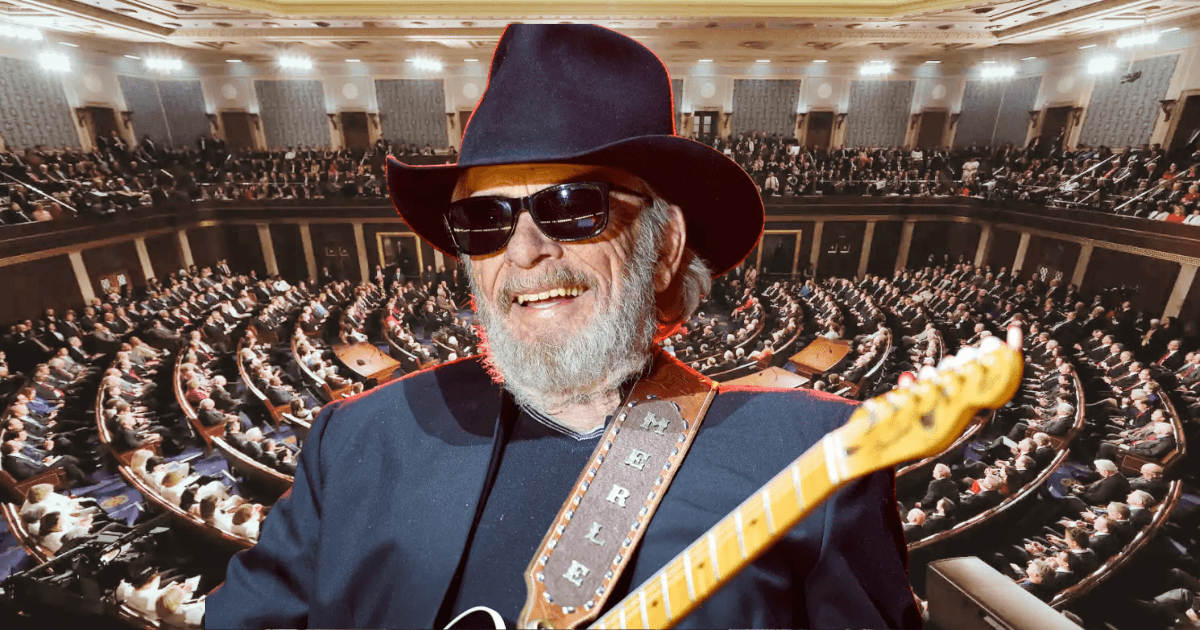
On This Date in Country Music History: Congress Gave Bakersfield Back to Merle Haggard
By: Brian Zwerner
Eight years ago today, on July 11, 2017, the United States House of Representatives did something it almost never does. It agreed unanimously on something. Every member of the House voted to rename the post office at 1730 18th Street in Bakersfield, California, as the Merle Haggard Post Office Building. House Majority Leader Kevin McCarthy, who represents Bakersfield, brought the bill to the floor himself. "For a man who went from Bakersfield High to San Quentin prison to the Country Music Hall of Fame," McCarthy said, "a building doesn't seem like much. But I hope that when people pass by the Merle Haggard Post Office Building in downtown Bakersfield, they will remember an icon of our community, an artist who never backed down, a man whose honesty about his own failings and willingness to pick himself back up inspired."
The honor was deserved. The story behind it is one of the great American lives country music has ever produced.
Born in a Boxcar
Merle Ronald Haggard was born on April 6, 1937, in Oildale, California, to parents who had migrated west from Oklahoma after a barn fire destroyed their farm in 1934. His father had gotten a job with the Santa Fe Railroad, and the family settled in a converted railroad boxcar near Bakersfield that his father had remodeled into a home. It was an almost mythically humble beginning for a man who would go on to help reshape American music.
His father died of a brain hemorrhage in 1946 when Merle was just nine years old. The loss sent him sideways in ways he would spend the rest of his life writing about. He bounced through juvenile detention centers, ran away, was sent back, and eventually drifted into the kind of trouble that small California towns in the 1950s offered in abundance. In 1957, he tried to rob a Bakersfield roadhouse, was caught, convicted, and sent to jail. A subsequent escape attempt landed him in San Quentin Prison.
San Quentin Changed Everything
What happened inside San Quentin is one of country music's most remarkable stories. While serving his sentence, a young Haggard was in the audience on New Year's Day 1958 when Johnny Cash walked out and performed what became Cash's first-ever prison concert. Haggard watched from the crowd as an inmate and decided that music was the road out. He was released from San Quentin in 1960 and went back to Bakersfield, where he began digging ditches for his brother's electrical company by day and playing the bars at night.
The Bakersfield Sound
What Haggard found in those bars was a musical movement that would make Nashville sit up and pay attention. The Bakersfield sound was a direct reaction against the slickly produced, orchestra-laden Nashville sound that dominated country radio in the late 1950s. It was harder, rawer, more electric, and more honest. Haggard and fellow Bakersfield native Buck Owens became its twin architects, recording with their own bands and largely free from the kind of corporate intervention that characterized Nashville production.
The two ruled the top of the Billboard country charts throughout the 1960s. Owens finished the decade with 18 number ones. Haggard took second place with 8, before racking up an additional 30 chart-toppers over the following two decades. His catalog became a body of work unlike anything else in country music. "Mama Tried." "Okie From Muskogee." "Working Man Blues." "If We Make It Through December." "Pancho and Lefty." Songs about real people living real lives, written by a man who had lived enough of his own to fill several of them.
In 1972, California Governor Ronald Reagan expunged Haggard's criminal record, granting him a full pardon. The man who had once tried to rob a Bakersfield roadhouse was now a Kennedy Center Honoree, a Grammy Lifetime Achievement Award recipient, and a member of the Country Music Hall of Fame. The city that had watched him go sideways watched him come all the way back around.
A Street, a Sound, and Now a Post Office
Bakersfield has never been shy about claiming Merle Haggard. A portion of 7th Standard Road near Bakersfield's Meadows Field airport was renamed Merle Haggard Boulevard in 2008. The Country Music Hall of Fame dedicated a major exhibit to the Bakersfield Sound. And eight years ago today, Congress made it unanimous. House Majority Leader McCarthy put it plainly on the House floor: "Merle Haggard was a man who knew America instinctively, because he lived an American life."
He died on April 6, 2016, his seventy-ninth birthday, at his home in Palo Cedro, California. Thirty-eight number ones. A life lived in full view, including the parts that were hard to look at. And a post office in Bakersfield that now carries his name. For a man born in a boxcar, that feels about right. Read his full bio on our website.