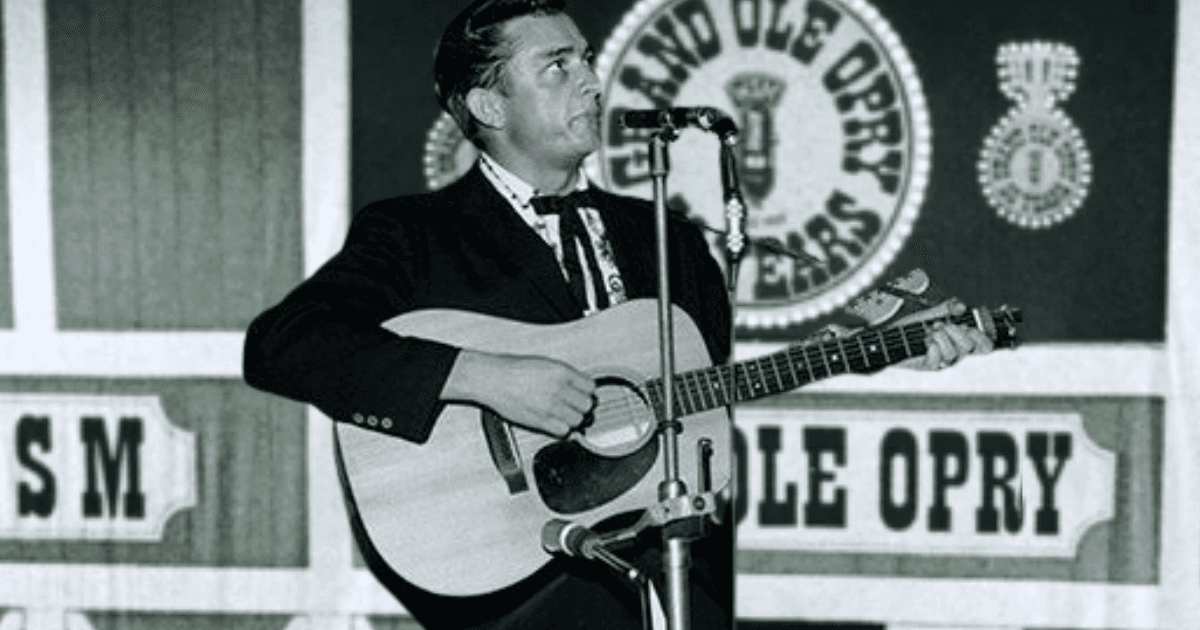
On This Date in Country Music History: Johnny Cash Walked Onto the Opry Stage and Changed Everything
By: Brian Zwerner
Seventy years ago today, on July 7, 1956, a twenty-four-year-old man in black clothes, black hair, and black sideburns walked into the Grand Ole Opry and kept the manager waiting for two hours before being allowed inside.
When Opry manager Jim Denny finally let him in, he looked Johnny Cash up and down and said, "What makes you think you belong on the Grand Ole Opry?" Cash replied simply, "Well, I've got a record in the Top 10. I think they'd like to hear me."
He was right. Cash performed "I Walk the Line," "Get Rhythm," and "So Doggone Lonesome" during his debut. At the time of his performance, "I Walk the Line" was still climbing the charts. It became his first number one hit two weeks later. The man in the black suit and his bandmates the Tennessee Two sliced through the polished pageantry of the Opry stage with something raw, spare, and unlike anything Nashville had heard. Country music would never be quite the same.
But the biggest moment of that night did not happen onstage. It happened backstage. It was that night's chance encounter with June Carter that changed the trajectory of Cash's life. Carter was already a member of the Opry as part of the Carter Family and had recently been touring as a backup singer for Elvis Presley. Cash told her he'd always wanted to meet her. She told him she felt like she already knew him. Neither of them had any idea what that meeting would eventually become.
What followed was one of the most celebrated and complicated love stories in country music history. Both were married to other people when they met, and it took more than a decade, a great deal of heartbreak, and some genuinely dark years before Cash finally proposed to Carter onstage in London, Ontario in 1968 and she said yes. But it all began on this date, in a backstage hallway at the Opry.
The relationship between Cash and the Opry itself, though, was not always so romantic. His personal demons jeopardized his standing with the Opry, and he was banned in 1965 after he smashed all the onstage lights with his microphone stand. Cash later reflected on what happened after the ban with characteristic bluntness. "I left and used that as an excuse to really get wild," he recalled, "winding up in the hospital with a broken nose."
The Opry and Cash eventually made peace. They mended fences a few years after the ban, following the enormous success of his At Folsom Prison album, and Cash was welcomed back to the stage he had always belonged on. He remained a beloved figure there until his death in September 2003.
Seventy years ago today, a young man in black waited two hours to be let inside and then walked out and became a legend. The Opry was never going to keep him out for long. Read his full bio on our website.